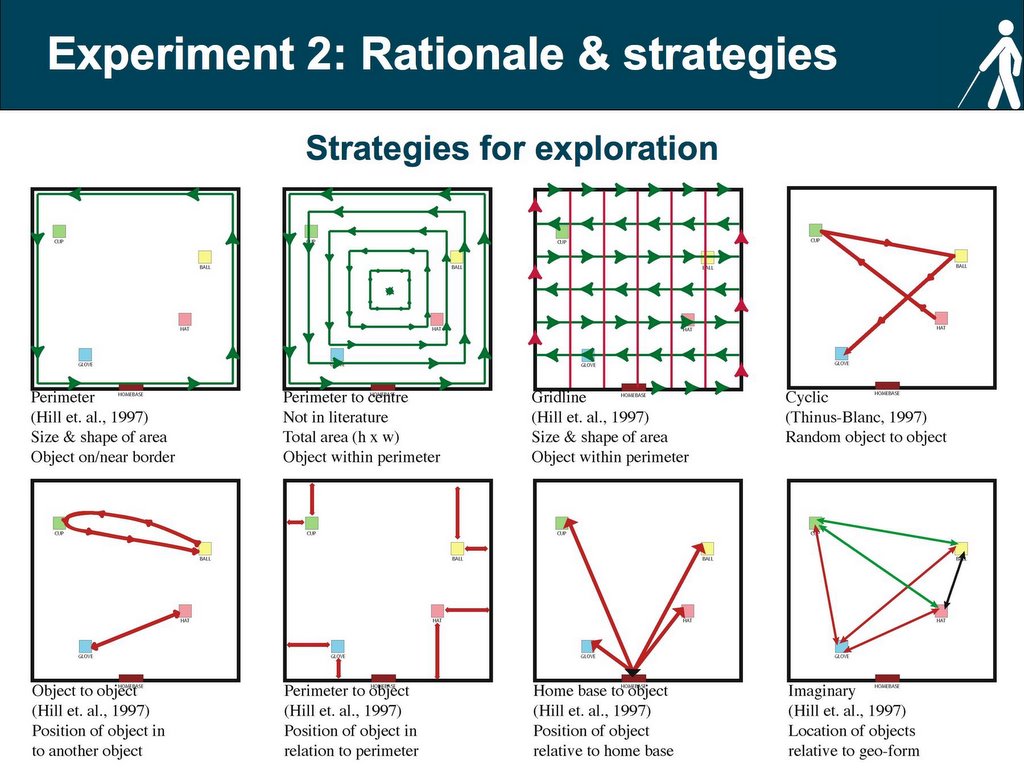
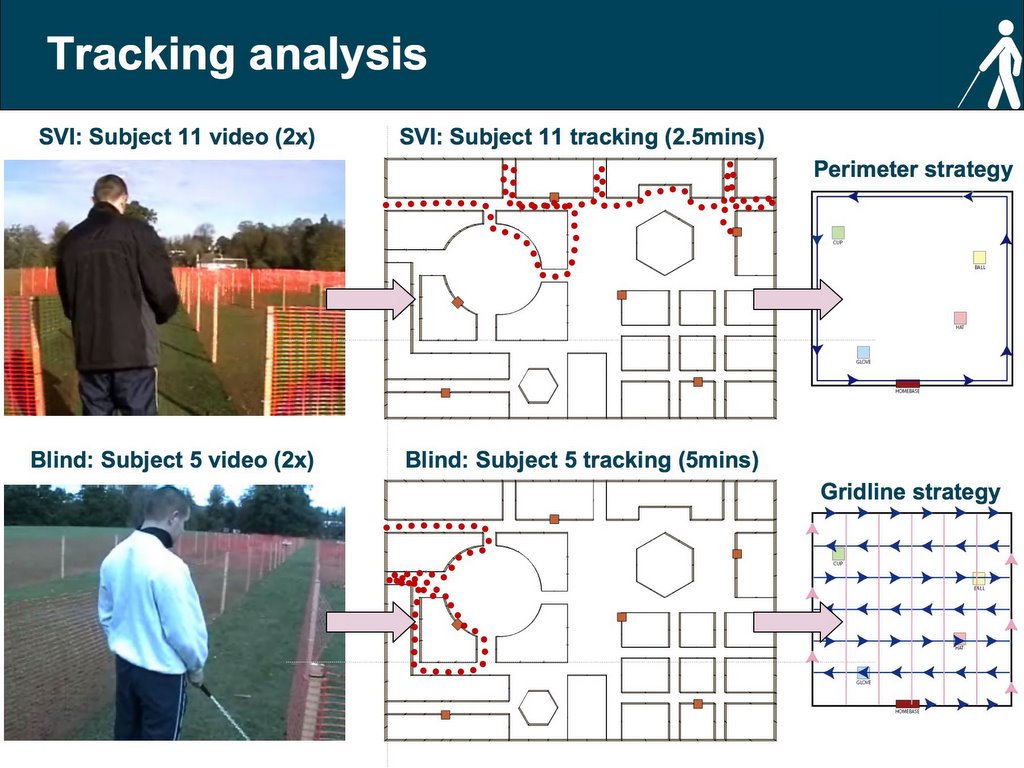
Thursday, October 26, 2006

Ecological perception: A few words on Gibson's theory and possible relation to visual impairment research

“… animal locomotion is not usually aimless but guided or controlled - by light if the animal can see, by sound if the animal can hear, and by odour if the animal can smell…The medium thus contains information about things… detecting this information, the animal guides and controls locomotion” – James J. Gibson

Whereas the representation and enrichment approaches drew heavily from the Cartesian dualist notion of perception and cognition (perception as a momentary stimulation of a set of sensory receptors separated from but complemented by a higher order cognitive processes), the ecological approach departs from an evolutionary perspective (Heft, 1997). For James J. Gibson, the father of ecological theory, the environment and the animal are inseparable - the existence of one implies the existence of the other. Mental processing and concepts of storage, enrichment and retrieval are replaced for relational and reciprocal links between the individual and the environment. The perceptual system has evolved in relation to the animal’s econiche and for this reason the study of human perception is relational and should begin with the environment and its reciprocity with the individual rather than how the individual perceives.

The ecological approach holds that perception is direct and present at birth. Perception is a bottom up process that depends on direct detection with no recourse to retinal, neural or mental pictures. That is, perception is not mediated by assumptions, preconceptions, expectations or mental images. Gibson believed that perception is designed for action. The process of information pickup “involves the exploratory activity of looking around, getting around and looking at things” (Gibson, 1986, pp. 147). Individuals perceive in order to operate in the environment and this perception is based on affordances or possibilities for action provided by the environment. The different sensory modalities are in themselves capable to pick up and make sense of change and invariance in the environment. Information is picked up through a process of resonance, similar to a radio, where individuals tune themselves to the environment. The process of storage and retrieval of information is erroneous since information is always available. To perceive is to be aware of the surfaces in the environment.

Affordances are picked up from the invariant characteristics of the environment and are detected depending on the perceiver’s species and current psychological state. They consign meaning to objects (Goldstein, 1981) and are directly perceivable. The concept of affordances is crucial to Gibson’s theory as it allows him to reject the more conventional notion that meaning is stored in long-term memory. Taking an evolutionary stand Gibson believed that a considerable amount of perceptual learning had already taken place throughout history making it not a necessity during a person’s lifetime. In proposing the notion of affordances Gibson shifts the focus to the environment by claiming that all that is needed to make sense of the environment is directly present (Eysenck & Keane, 1990). Learning consists of the improvement of perceiving and is mediated by practice and the education of attention not memory.

Gibson is said to have implemented the temporal element in perception (Eysenck & Keane, 2005). However, his focus was not on time per se but on cycles, sequences, events and changes. Events are the primary realities and time is filled with events. The bulk of Gibson’s theory can be said to revolve around the information acquired through persistence under change. In this sense, ecological perception focuses exclusively on the reciprocity of the concepts of variance and invariance - how information is picked up by the interplay of locomotion and the non-changes. It is worth noting that for the most part the theory is concerned with of optic flow information and the kinaesthetic quality of vision. Events cause “disturbances” in the invariant structure of the optical array (different types of events causing different types of disturbances). Goal-oriented locomotion depends on sequential optical array information and the reciprocal interplay between the variant and invariant structures of the environment. Locomotion is guided by locating the invariant features that specify a destination and by keeping focus of the optical outflow towards the destination.

The theory also accounts for the role of perceptual systems other than vision. The body in motion and proprioception are seen as important sources of stimulus information to vision and the other senses. Gibson criticized the Gestalt notion that the senses pick up individual information that is made to cohere during the process of perception. For Gibson, the senses were perceptual systems in themselves. Perceptual systems that are both propriosensitive and extereosensitive - self and environmental perception are complementary. Movement affords information about the environment and self that is multiple and concurrently gathered. The “individual not only sees himself, he hears his footsteps and his voice, he touches the floor…he feels his head turning, his muscles flexing, and his joints bending” (Gibson, 1986, pp. 115).

Gibson denied that wayfinding is mediated by a sequence of turning responses conditioned by stimuli (response chain theory) or by consulting an internal representation or map of the environment (cognitive mapping theory). He believes that the only appropriate way to understand wayfinding is through the theory of reversible occlusion. For this he introduces the concept of vistas and transitions. Vistas are defined as extended regions (semi-enclosures or a set of unhidden surfaces), a layout of environmental features presently visible, (Heft, 1996) that are serially connected, unique and reversible. Transitions are more salient and allude to parts of the path of travel where the individual can begin to capture the next vista. Moving from one place to another consist of “the opening up a of the vista ahead and closing in of the vista behind” (Gibson, 1986, 198). In this manner, to wayfind in an unknown environment consists of sequentially selecting from a choice of vistas, whose uniqueness can act as a landmark, presented by the environment. As follows place learning consists of learning the affordances of different places and learning how to distinguish among them.

In regards to this thesis, perhaps the most relevant feature of the theory is the notion perceptual information is primarily used in the organization action (Eysenck & Keane, 2005). Locomotion and manipulation are not triggered by stimuli outside the body or initiated by commands inside the brain but dependent on the active control of information and by seeing/perceiving oneself in the world. The individual is aware of the environment while actually moving through it. Although Gibson held that the control of information was predominantly visual he acknowledged that proper awareness could only be achieved through movement. To perceive “involves the coperceiving of the self “ (Gibson, 1986, pp. 240). The information for perception always comes in two – in relation to the environment and to the self. In this manner, exploration is assigned a crucial role in perception. Active (focus on active rather passive) exploration is required in order to separate invariants from variants and the eventual awareness of information. Exploration is what allows an observer to continuously learn about surfaces (their layout, substance, events and affordances) as perception itself becomes finer, richer and fuller as one explores (Mace, 2005).

In a series of experiments on the role of vistas and transitions in wayfinding, Heft (1983) was able to show that in route learning, transitions (or periods of saliency maximal change in the perspective structure) are more important than vistas. Participants who viewed a movie consisting only of continuous transitions in a particular route were particularly attuned in their detection and performed significantly better in route retracing exercise when compared to those who viewed a movie consisting only of vistas. This is of particular value for perception in the total or partial absence of vision for two reasons: First, transitions unlike vistas do not necessarily need to be visual. A transition can be a particular intersection in a street network that can be detected by a change in curvature orientation. Furthermore, the concept of successive transition implies some form of structure or hierarchy. Wayfinding is inevitably temporal and can be described as navigation within “a nested hierarchy that unfolds over time (Heft, 1996, pp. 122). Notice here that the basis of wayfinding is not a mental representation but the access or presence of sequential information.

It may seem strange to devote so much attention to Gibson’s theory considering it is almost entirely based on visual information. Nonetheless, the notion of action, locomotion and temporally structured navigation has important implications for wayfinding in the total or partial absence of vision as blind and visually impaired individuals are forced to move in order to perceive. It is the reciprocity of information and action that allows for the continuous updating and orientating necessary for accurate navigation. Instead of a succession of vistas (although navigation using continuous vistas is still plausible in the partial absence of vision) the blind or visually impaired individual can use a proprioceptive/environmental (action/perception) loop system based on transitions. With the risk of extrapolation, what we want extract from Gibson’s ecological theory is the inseparability of the individual and the environment and the active perception of reality through succession or successive situation transitions (Heft, 1996). The difference lies on the idea that information is controlled via proprioception and the operation of the other senses. This is in tune with the Gibsonian notion of perceptual systems where information is redundant and concurrently gathered. As we shall see on the following chapters much of Carreiras and Codina (1992) and Susanna Millar (1994) amodal theories of spatial coding are based on these assumptions.

The ecological approach differs substantially from the traditional approaches in that it rejects the notion of input processing in perception. Its relevance to perceptual psychology however, is undeniable. First, it allowed for a consideration of direct perception by showing that a considerable amount of information about the environment can be directly perceived. The approach also links perception to locomotion rather than the static viewing of stimuli, as it is through the moment-to-moment changes in the optic array that one makes sense of the world.

There are some limitations to this approach. First, while Gibson acknowledges that supplementary information about movement can be picked up by the haptic system he still held the extreme view that locomotion is strictly registered by vision in that the visual system yields the only reliable information regarding displacement (Gibson, 1986, pp. 126). As we shall see, there is a considerable amount of useful wayfinding information that can be assembled through muscle memory or proprioception. Second the theory has also been criticized by the manner in which he treats meaning in perception. Although Gibson went through great lengths in discussion of affordances it is hard to believe that stored knowledge in long-term memory does not play a role (even if minor) in recognition and perception. For an in depth criticism of Gibson’s representation free theory please refer Fodor & Pylyshyn (1981).

Gibson has also often been criticized by the lack of experimental evidence to support his theory. If fact most of the experiments reported in his work are his own. In addition, the actual design of experiments to study the role of invariants can be very complex and have only recently been taken up by researchers (Goldstein, 1981). Finally, perhaps the biggest flaw is Gibson theory is the ineffective almost nonchalant manner in which he deals with the acquisition of configurational or global knowledge of an environment. He believed that the control and organization of vistas through exploratory locomotion would eventually lead for the whole of the habitat to be apprehended. This “complete” apprehension was equivalent not necessarily to a bird’s eye view of the environment but to being everywhere at once. As we have already seen and as it will be continually argued, it seems hard to deny, irrespective to which representational or constructivist theory we adhere to, that at least some part of the formation of configurational knowledge depends on cognitive processes that make sense of discontinuous perceptual encounters.

Saturday, October 21, 2006

CASA 4 Cancer Research

So...after very little training we have decided to organise a team to represent CASA for a 10k run for cancer research UK. if you would like to sponsor the team you can donate over the internet by clicking here.

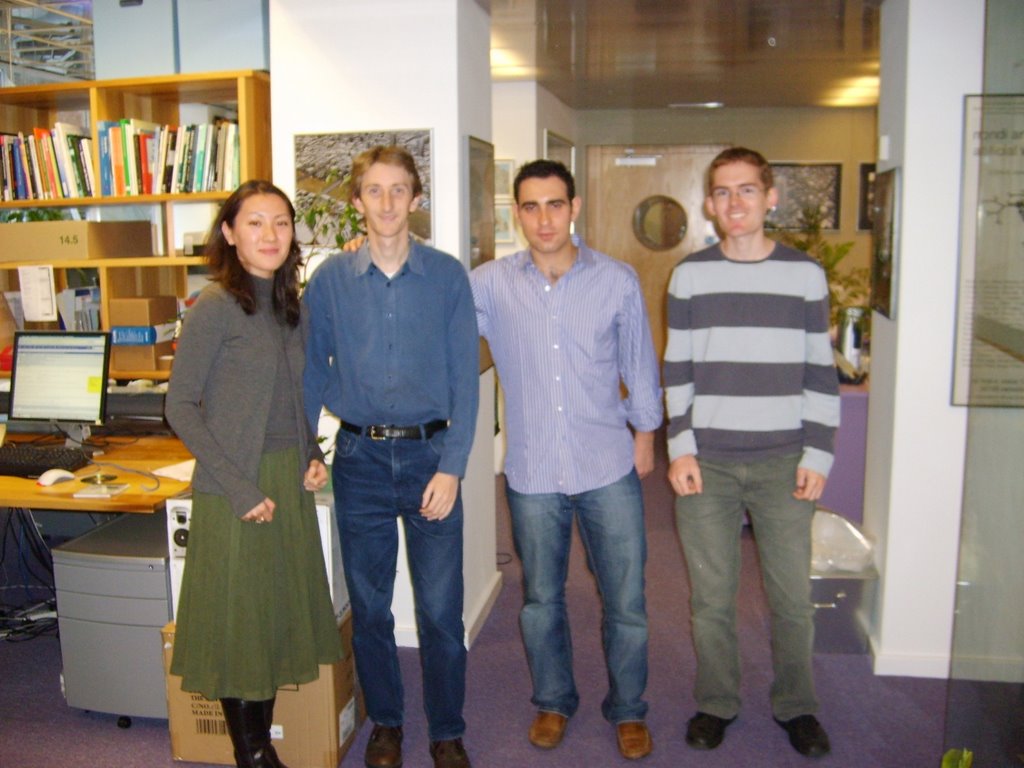
The team will consist Kay Kitazawa, Joel Dearden, Maurizio Gibin and myself. The event will take place on the 29th of Ocotber at Dorney Lake and all are welcome to come and cheer! In fact, we need all possible cheering and encouragement. For further details on the actual venue click here.

Sunday, October 01, 2006

Spatial Cognition 2006 (Bremen, Germany)

Click to download my paper and presentation at the Spatial Cogntion conference last week in Bremen, Germany. The title of the paper is "Beyond statistical testing: Individual differences and the content and accuracy of mental representations of space".

Apart from the good quality of papers, thank you all (Irene, David, Ana, Renato, Cristophe, Samvith, Magda, Rodrigo, Alasdair, Rob, Stephan) for the entertaining after conference hours.

- God I wish I wish I was still on that boat...

RLSB sketch

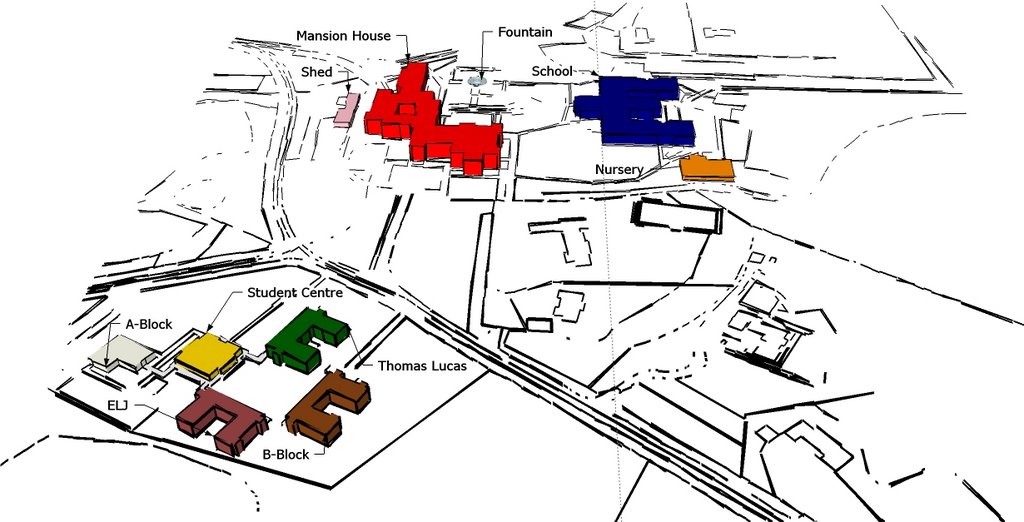
Playing around with SketchUp software in the final design of the RLSB campus

Wednesday, August 30, 2006

Spatial Cogntion 2006


Conference is taking place from the 24 to the 28 of September 2006. Click here for more details.

I will be presenting at the "spatial learning and individual differences" workshop.

Title of paper: Beyond statistical testing: Individual differences and the content and accuracy of mental representations of space. I will post the paper and powerpoint in this blog as soon as I get permission from the conference.

Thursday, August 10, 2006

I never thought I would be doing this...

I'm still working on this post so it will take a few days. Anyway, here it is:

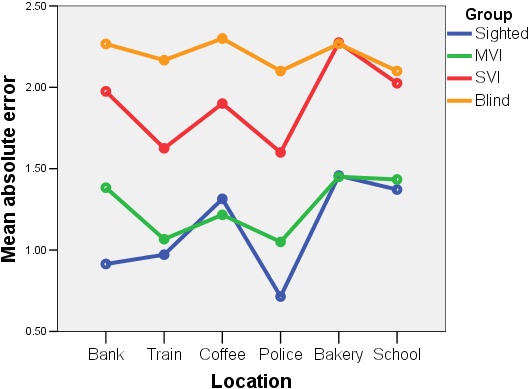
A repeated measures ANOVA was used to analyze the data from the pointing and the distance estimation taks. For the pointing task (figure 1)


Saturday, August 05, 2006

Tuesday, August 01, 2006

Saturday, April 22, 2006

Maze tracking

This is just a small example and it is unfortunate that the quality of the video is quite low and the change in colour between the different sections of the exploration cannot be clearly seen. I wanted a small file for now and I am still trying to figure out what is the best compression method. If you right click on the actual movie and select "full screen" you will be able to get a better image and differentiate between the various sections of the track.

The animation`was created with the tracking analyst extension in Arcmap. It shows the exploratory pattern of a visually impaired subject in the second experiment of my research. This subject's exploration lasted for 13:46 minutes (the animation takes 2 minutes) and it was broken up in seven different sections (the X in the animation indicate each section break). The idea is to comapre the strategy(s) used by the different subjects in each of these sections (and also for the whole exploration) and relate it to their performance in a series of spatial tasks.

I am still trying to isolate the possible wayfinding strategies that a subject may use during exploration. For the moment it is quite clear tha for the first two sections the subject in the video used a "perimeter" strategy and was able to locate the six different tables in the maze. During the 3rd and 4th section the subject retraced his steps along the perimeter making sure all tables were revisted. For the remaining time the subject used an "object to object" strategy between the tables in the southern part of the maze.


Powered by Castpost

Sunday, April 16, 2006

Found the quote!

...so for the past year I have been looking for the opening quote of my dissertation. I think I got it!!

"...on ne voit bien qu'avec le coeur. L'essentiel est invisible pour les yeux."

"...it is only with the heart that one can see rightly; what is essential is invisible to the eye."

-Antoine de Saint-Exupéry (Le Petit Prince)

Wednesday, April 12, 2006

Null hypothesis significance testing, individual differences and the ethics of visual impairment research

“Good research is difficult to do, but bad research is not worth doing at all” – David Warren


It is amazing that in the third year of my Ph.D. I find myself home on a Saturday evening (yes, I know what an exciting social life) writing about statistics. Yet, I have spent the past few days reviewing several articles in geography and psychology on the representation of space without vision that have relied on inferential statistics in the presentation and interpretation of results. These have not been pleasant days to say the least as some researchers continue to employ a variety of methods without a clear understanding of their purpose and meaning. More often than not, the probability values (p values) in null hypothesis significance testing (NHST) are misinterpreted which inevitably lead to false conclusions about the data. It was not long before I realised that a review of NHST was in order. During the past two decades, NHST has been under severe criticism. My goal is to present a brief review of this more than justified critique and discuss a variety of complimentary methods. This is by no means an in depth review and I suggest that anyone conducting this type analysis have a look at the list of books and articles below. While you are at the library it would probably not hurt to pop in the mathematics section and browse thorough John Tukey’s book Exploratory data analysis. As we shall see, the majority of the methods that should be used as either an alternative or complement to NHST are derived from Tukey’s work.

Chatfield, C. (1985). "The initial examination of data." Journal of the Royal Statistical Society. Series A (General) 148(3): 214-253.

Cohen, J. (1990). "Things I have learned (so far)." American Psychologist 45(12): 1304-1312.

Cohen, J. (1994). "The earth is round (p <.05)." American Psychologist 49(12): 997-1003.

Coe, R. (2000). What is an 'Effect Size'? University of Durham. 2000. http://www.cemcentre.org/ebeuk/research/effectsize/ESguide.htm

Kline, R. B. (2004). Beyond significance testing: Reforming data analysis methods in behavioral research. Washington, DC, American Psychological Association.

Schmidt, F. (1996). "Statistical significance testing and cumulative knowledge in psychology: Implications for training of researchers." Psychological Methods 1(2): 115-129.

Smith, F. A. and A. D. Prentice (1993). Exploratory data analysis. A handbook for data analysis in the behavioural sciences: Statistical issues. G. Keren and C. Lewis. Hillsdale, New Jersey, Lawrence Erlbaum Associates Publishers: 349-390.

Wainer, H. and D. Thissen (1993). Graphical data analysis. A handbook for data analysis in the behaviour sciences: Statistical issues. G. Keren and C. Lewis. Hillsdale, New Jersey, Lawrence Erlbaum Associates Publishers: 391-458.

Tukey, J. W. (1977). Exploratory data analysis. Reading, Mass.; Don Mills, Ont., Addison-Wesley Pub. Co.


So why am I doing this?

I would like to think that I am not stating the obvious but rather what should be obvious. When preparing this manuscript I could not help but wonder whether it really is a necessary part of my research. After all, a review of statistics seems like fairly basic material to cover in a doctorate thesis. It was not long before I discovered that many articles on blindness and visual impairment published in academic journals in geography and psychology have not taken into account some of the dangerous limitations of NHST and the noteworthy alternatives that have been proposed.

These disciplines have a long tradition of comparing between different groups of participants. Much of the research has focused on the way in which individuals within a group are similar to one another but different from other groups. In this case, comparing the abilities to mentally represent space of the sighted in relation to the visually impaired and blind. Conversely, very little attention has been paid to the ways in which individuals within a specific group differ from one another (Lewis & Collis, 1997). Comparing the abilities between individuals in different groups can provide important information on the role of vision in the representation of space and can assist in the formulation of theories on sensory substitution and proprioception. At times however, this method of comparison can be problematic especially when the adopted methodology does not allow for individuals in a specific group to fully express their abilities. This is often the case in experiments that compare the performance of blind and visually impaired subjects against a blindfolded control. In such cases the blindfolded control usually operates at a disadvantage as they are forced to rely in different strategies to problem solve. Similar problems occur in research that uses fully sighted controls. In many cases, the type and amount of information provided by the researcher for the completion of a specific spatial task tends to vary between groups. In this manner, Millar (1997; 2000) argues that performance is not based on actual spatial competencies but differences in the provision and access to the information that is necessary to complete the task. Finally, comparative approach does not offer the researcher any insight on the underlying processes that make up behaviour and influence these abilities.

The phenomenological world of the visually impaired is qualitatively different from that of the sighted (Rosa, 1993). If the two years I have spent working at the Royal London Society for the Blind have taught me anything is that individuals with visual impairments and blindness form part of a population that is extremely heterogeneous that many times cannot (and should not!) be classified in specific groups or categories. The tradition of making comparisons between groups assumes that individuals that make up a particular group share the same characteristics. In the majority of cases people with visual impairments are often grouped together because they have been diagnosed with the same eye or medical condition, share the same aetiology or because they have performed at a specific level in psychometric tests. Unfortunately, these types of classification are somewhat restrictive. Consider the case of individuals who are diagnosed with the closest matched condition. In such cases the expert does not know the exact nature of the impairment and bases his diagnostic on the present manifestation of symptoms and behaviours. Some of my students have been diagnosed with a specific condition (most of the time retinitis pigmentosa) although they do not exhibit many of the characteristics that the condition incurs. This type of unforced professional error cannot account for latent behaviours or symptoms and may cause a significant amount confusion if these individuals are mixed together in the same group. The fact the retinitis pigmentosa is a degenerative condition further complicates matters.

The lack of vision cannot fully account for the differences. Such strict causality is theoretically sterile (Warren, 1994) and does not recognize the growing amount of evidence on the spatial abilities of the blind and visually impaired. While the nature and history of the condition can have important implications for the development of spatial understanding concentrating on the pathology of the impairment is clearly not enough. The development of spatial abilities is also mediated through interaction and experience with the environment and culture. In this manner, while the group may be similar in either a medical, functional or clinical diagnosis (or any combination of these) is still not entirely homogenous. The comparative approach can be beneficial if the researcher is capable to control for a certain amount of cohesion within each specific group. This method is better suited when large and clear differences exist. However, when differences are slight or inexistent a differential or individual differences approach may be more suitable.

The individual differences approach accounts for the variety of effects that different factors and conditions have on the specific individual (Lewis, 1993). It focuses on two questions that cannot be fully explained by the comparative method. First, what is the nature of the variation? Second, what are the causes leading to such variation? Research on visual impairment and blindness is filled contradictions and it is not uncommon to find similar studies with conflicting results. In this manner, the first and a crucial step of this approach is to provide a detailed description of the characteristics of the group and each participant as an individual. Many discrepancies between studies can often be attributed to the fact that researchers were working with samples that were not equivalent (Warren, 1984). The second step consists of identifying the correlates and the reason and cause(s) for the variation. The individual differences approach combines the logic of the case study technique with the advantages of quantitative methods.

There are several difficulties associated with this approach and these are mainly related to vast array of factors (physical, clinical and environmental) that even if identified can have a different effect on each participant. However, it is exactly this complexity that should interest researchers. Good research is the one that not only identifies the statistical significance of an effect but also the magnitude and reasons that can explain it. Explaining the difference is what will aid professionals in the design of intervening programs that are catered to the group or the specific individual.


How does this relate to null hypothesis testing?

In the final chapter of his seminal book Blindness and early childhood development David Warren (1984) expresses his disappointment about the quality of past research. This dissatisfaction stems mainly from methodological and analytical weaknesses that fail to account for the heterogeneity of the population. Researchers often overlook the need for detailed descriptions of the various characteristics of the population. In fact, the attention that should be ascribed to these descriptive techniques is usually forfeited in exchange for statistical significance testing that more often that cannot provide any explanation regarding the presence of an effect. Perhaps the most obvious reason behind the ineffectiveness of NHST is the fact that the tests most commonly used (Student’s t-test and Analysis of variance) rely on group averages (mean) and are based on the assumption of a normal distribution. An analysis solely based on group means is unrealistic and short sighted. Researchers studying visual impairment and blindness cannot afford to “indulge in the luxury” of studying only group means and disregard any variations from it (Warren, 1984, p. 298). A certain amount of variability will always exist and some reasons can almost certainly be traced to determinant factors. It is the duty of the researcher to record and report these characteristics and make the necessary efforts to explain the presence/absence of an effect not only for the group but for subgroups or specific subjects that do not follow the trend.

The history of psychology is filled with examples of renowned researchers (Piaget, Vygotski) that have managed to reach important conclusions without relying on significance testing. Unfortunately, many are still under the illusion that results accompanied by significant probabilities values (p values) are more robust and a fundamental requirement for publication. As we shall see, the null hypothesis is always false and rejecting it is only a matter of securing a large enough sample. In addition, results that are not statistically significant should also be considered and reported. Not finding an effect (or a difference) can provide relevant information about the reliability and adequacy of the chosen methods and can lead to a reassessment of the entire experimental design. Results that fall short of statistical significance will also force the researcher to consider the other array of “self selected” or “status” variables that are brought by each individual participant and are beyond the control of the experimenter.

We are now faced with an important and yet somewhat paradoxical question. If the need to change from a comparative (or at least include) to an individual differences approach was identified in the early 80’s why have so many researchers failed to incorporate this in their research design? Why after having identified serious problems with NHST do researchers continue to rely exclusively on statistical significance to explain their results?


The problems with NHST

The problems associated with NHST are not new. In fact they have been around for so long that one cannot help but feel ashamed that for past two decades a considerable amount of research has been conducted (hypotheses have been tested) under such an inadequate and insufficient system. A recent article on the Economist (January 2004) criticizes the over reliance on statistical significance testing rather than logical reasoning on the part of social scientists. It denounces the misuse of statistical data and argues that more often than not researchers do a lousy job when manipulating and making sense of numbers. The wide availability of computers and the ease of use of several sophisticated statistical packages have fuelled a bogus statistical revolution whose main order is to test for significance. Statistics can be deceptive especially when they are used to explain human behaviour. Significance testing does not tell us whether differences actually matter or provide any explanations. The researcher’s dependency on significance testing has lead to variety of problems especially when these have failed to separate statistical significance from plausible explanation.

Despite years of ferocious criticism and recent guidelines published by the American Psychological Association (APA) many researchers in geography and psychology continue to use NHST to interpret and explain their results. Perhaps the biggest problem stems form the fact that there is lack of comprehension regarding the concept of statistical significance. Results from significance tests can be somewhat deceptive at times giving the illusion of objectivity and it is important that researchers understand the purpose and implications of these tests before applying them. Cohen (1994) points to three common mistakes frequently made by researchers: 1-The misinterpretation of p as the probability that the null hypothesis is false. 2-That when we reject the null hypothesis p is the probability of successful replication. 3-That rejecting the null hypothesis affirms the theory that led to the test. More recently, Kline (2004) has outlined several false conclusions that derive from these misinterpretations. These authors among several others (Chatfield, 1985; Schmidt, 1996; Smith & Prentice, 1996) have put forward a variety of methods such effect size measures, confidence intervals, point estimates that combined with graphical tools that can be used as a replacement or complement to NHST. Before we can review these methods and critiques we must first clarify the purpose of NHST. What does the p value really tells us? And what can we conclude when a result is said to be statistically significant and we can reject the null hypothesis.

NHST indicates the probability (p) of data (or more extreme data) given the null hypothesis is true. The p value is a probability statement. It is the measured probability of a difference occurring by chance given that the null hypothesis is actually true. In other words it measures the strength of evidence for either accepting or rejecting the null hypothesis. A small p value suggests that the null hypothesis is unlikely to be true. It does not tell us the probability that the null hypothesis is false. Clearly these are two different things. However, much research has been conducted under the illusion that the level of significance in which the null hypothesis is rejected (usually .05) is the probability of its veracity (Cohen, 1994). The verity of the null hypothesis can only be ascertained through Bayesian or other type of statistics where the probability is relative to the degree of belief and not frequency (Cohen, 1990).


The six fallacies

As Cohen (1990) has impeccably noted, what researchers would like to know is how likely there are differences in the population given the data. Unfortunately all that NHST can provide is information on how likely is the data, given the assumption that there are no differences in the population. The list below is an adapted version of Kline’s (2004) review of the typical false conclusions adopted by researchers who misinterpret the meaning of the value of p in NHST:

Magnitude fallacy: This is the false belief that the p value is a numerical index of the magnitude of an effect (strength of the relationship). That is, the lower the p value the larger the effect. Psychology and geography journals are filled with examples that deliberately regard a difference at (.001) level as more important than one at the (.05). These are wrong interpretations given that the p value only indicates the conditional probability of the data given that the null hypothesis is true. Significance levels are highly dependent on sample sizes to the point that “highly significant differences in large sample studies may be smaller than even non-significant differences in small sample studies” (Schmidt, 1996, p. 125). Increasing the sample size will almost always lead to results that are statistically significant. As we shall see, the effect size is what tells us about the magnitude of an effect - strength of the relationship between the independent and dependent variables.

Meaningfulness/causality fallacies: The false belief that rejecting the null hypothesis automatically asserts the truth (proves) of the alternative hypothesis. Rejecting the null hypothesis does not imply a causal relation. The alternative hypothesis is only one of many possible hypotheses and rejecting the null hypothesis does not confer exclusivity to a specific theory. There are may be a variety of possible intervening and yet to be identified factors not covered by the alternative hypothesis. Replication is perhaps the best evidence.

Failure/quality fallacies:
The wrong conclusion that if you do not reach significance at least at the (.05) level (if the null hypothesis is not rejected) than the study is a failure. In other words, reaching significance is what dictates the quality of the study. Type II errors can occur when statistical power is low or the overall research design and methods are inaccurate. Failure to reject the null hypothesis can be an important part of the research. It forces the researcher to look for the reasons behind this lack of difference/significance and allows for a critique of the actual data and methods. In some cases, failure to reject the null hypothesis along with a well-sustained explanation of the data will raise questions about the validity of past research.

Sanctification fallacy: This is related to the failure/quality fallacies and deals with the fact that many researchers credit a finding as significant if it falls between the sanctified (.05) and (.01) level but consider the difference or relation insignificant if the value of p is larger, even if only marginally larger. As Rosenthal (1989) pointed distinctions should not be so black and white as “surely, God loves the .06 nearly as much as the .05”. The purpose of good research is not make mechanical “yes and no” decisions along a sanctified significance level but to formulate clear and well backed theories whose verity will depend on successive replication. It is not a question whether the difference is significant but whether it is interesting.

Equivalence fallacy: This is the belief that failure to reject the null hypothesis automatically means that the population effect is zero and that the two populations are equivalent. Again, this is similar to the meaningfulness fallacy and as Kline (2004) notes "one of the basic tenets of science is that the absence of evidence is not evidence of absence". If the null hypothesis is not rejected nothing should be automatically concluded. The symmetrical relation “if it is not significant, it is zero” is erroneous.

Replication fallacy: Rejecting the null hypothesis does not allow us to infer anything on the probability that another study which replicates the research will also end up rejecting the null hypothesis.


Effect size

Kirk (1996) argues that NHST is a trivial exercise given that rejecting the null hypothesis is only a matter of having a large enough sample. The Fisherian null hypothesis scheme does not consider the magnitude of effect – the size of the difference. The value of p only indicates the probability of an effect occurring by chance. When we have enough evidence to reject the null hypothesis we can only identify the direction of an effect (A > B or A < >[Effect size = mean of experimental group] – [mean of control group] / standard deviation


In situations where the control and experimental groups cannot be distinguished it is up to the researcher to decide which standard deviation to use as long as it is reported. A solution is to use the average of the standard deviation of the two groups. Hedge’s g is the ratio of the mean difference divided by the pooled standard deviation and allows for a correction of biases due to unequal and small sample sizes.

Effect size indicators have existed since the early 30’s but have been for the most part ignored by researchers in the social sciences. As noted by Denis (2004) a survey of articles in the British Journal of Psychology and the British Journal of Social Psychology revealed that not a single article published between 1969 and 1972 ever discussed effect sizes. More shocking is the fact that when effect sizes were calculated these tended to be very low for the majority of cases. Nowadays, this blatant disregard to what seems to be an essential part of the research design and almost a necessity for understanding results has finally caught the eye of the American Psychological Association. The APA now asks for researchers to report effect sizes when presenting their results. There is an abundance of software that will automatically calculate effect sizes and there should be no excuses for researcher not to report it.


Interpreting effect sizes

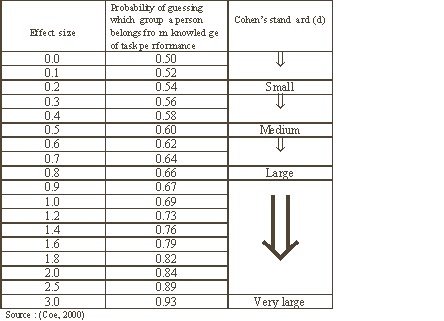
There are different ways to interpret effect sizes. The table below is an adapted version of Coe (2000). For a more in depth discussion on the interpretation of effect size please refer to:

http://www.cemcentre.org/ebeuk/research/effectsize/interpret.htm


Table 1. Effect size – Interpretation


Effect sizes can be converted into statements about the overlap between two groups. This can be a valuable tool when discussing the magnitude of the difference between groups. The first column in the table presents the actual effect size. The second presents the probability of guessing which group a person belongs on the basis of their performance on a specific task. If the effect size is zero than the probability of a correct guess is fifty percent. As the effect size increases, the overlap decreases and the chances of correctly identifying the group increases.

Cohen (1990; 1994) has written substantially on effect sizes and provides some guidelines for their interpretation based on the effect size of differences that are familiar. Cohen’s d is a measure of the distance between means (Denis, 2003). As noted in the table above an effect size of 0.2 is considered small and can be compared to the difference between the heights of fifteen and sixteen year old girls. An effect size of 0.5 is regarded as medium and compared to the difference in heights between fourteen and eighteen year old girls. Finally, an effect size of 0.8 is considered large and Cohen equates it to the difference in heights between thirteen and eighteen year old girls. As mentioned above effect sizes can also be reported using Hedge’s g. This is the ratio of the difference between two means divided by the combined estimate of the standard deviation.

There are no exact guidelines as to what indicates a small or large effect. Researchers should be encouraged to report both the probability value and the effect size. Reporting both values will prevent the researcher from falling in the trap of reaching significance but not knowing the strength of the relationship (magnitude of difference). Here it is important to note that effect sizes are descriptive and not inferential. They are descriptive of the sample data and offer no information on the degree of association for the rest of the population. In addition, effect sizes should be interpreted with particular care, as they are highly dependent on the situation. It is up to the investigator to become acquainted with different characteristics of the data and develop and understanding of what constitutes a small or large effect. This last recommendation should not be taken lightly especially in the behavioural sciences where a small effect can have very important implications.


Statistical significance vs. clinical significance

Effect sizes can provide information about the practical (clinical) significance of an effect. An effect can be statistically significant and mathematically real but too small to be important. For this reason it is important to differentiate between statistical and practical significance. As mentioned above, statistical significance does not provide any information about the size of an effect and is susceptible to differences in sample sizes. Trivial differences can have very low p values if the size of the sample is large enough. Practical significance is a deductive statement (judgement) about the utility of a result. It will depend on the researcher’s understanding of the situation, practical knowledge and experience. Moreover, the magnitude of an effect should not be interpreted as synonymous with practical significance. It is possible to have a small effect size that is of high practical importance and vice-versa.


Confidence intervals

Relying on information from samples of a population will always lead to some level of uncertainty. The confidence interval quantifies this uncertainty. It is a range of values within which the population parameter is likely to be included. This is calculated from the sample data and usually reported at the 95% level. In this manner, the confidence interval for the difference between to means is a range of values where the difference between the means of two populations may lie. The width of a confidence interval can provide some information about how certain we are about the difference in means. In general, the narrower the confidence interval the higher is the precision of the estimate. The confidence interval will tend to be wide when the sample size is small and the scores are less homogeneous

Confidence intervals are a useful tool for the interpretation of results and an appealing alternative to NHST given that they can also provide information as to whether the difference between two means is statistically significant. When looking at the confidence interval of a difference one can easily check whether the interval includes a value that implies “no effect”. If not stated a priori this value is usually assumed to be zero (null hypothesis).

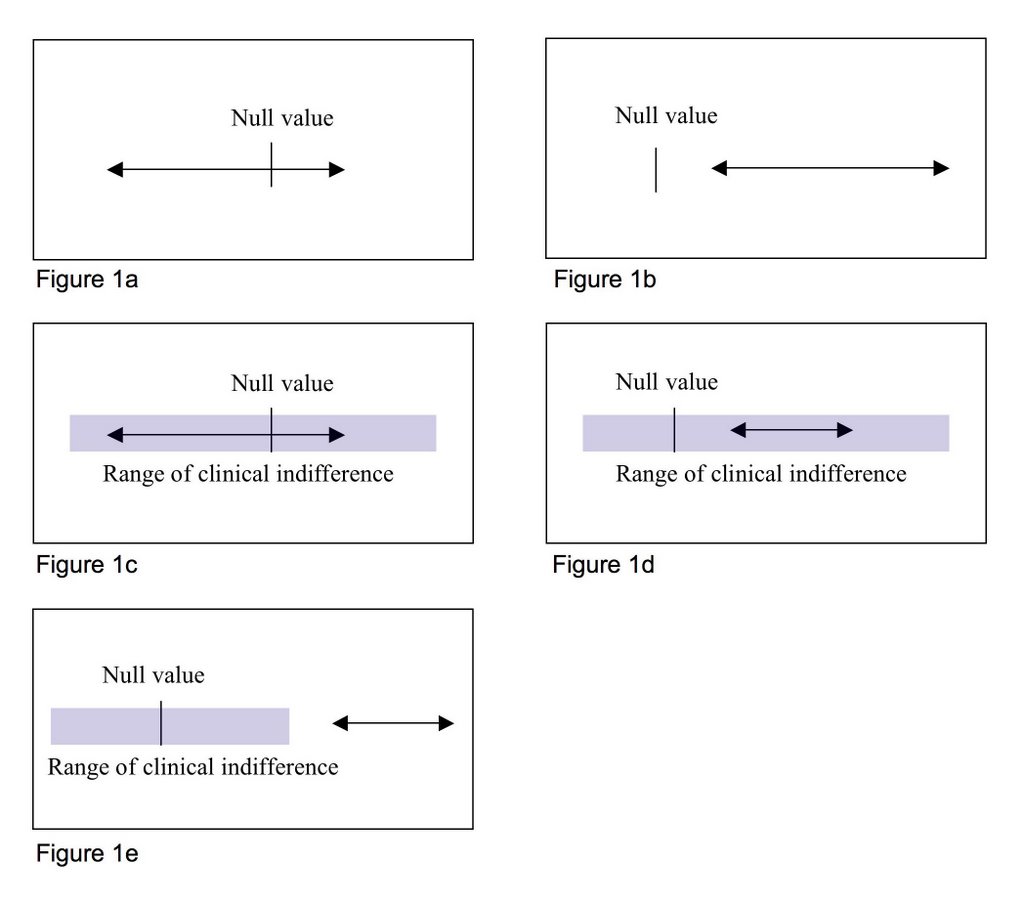
Simon (2006) provides several graphical examples as to how researcher can use confidence intervals to interpret their results. Figure 1a is an example of a confidence interval that includes the null value. In his case, the mean difference is not statistically significant. Figure 1b is an example of statistically significant difference where the null value falls outside the limits of the confidence interval. Confidence intervals also allow the researcher to interpret whether a difference is clinically significant. As mentioned above a difference can be statistically significant but of no practical value if falls within the range of clinical indifference. Figure 1c illustrates a situation in which the confidence interval includes the null value and these fall within the range of clinical indifference. Here the mean difference is neither statistically or clinically significant. In figure 1d the mean difference is statistically significant but of no clinical value given that the range of clinical indifference covers the totality of the confidence interval. Finally, figure 1e is an example of statistically and clinically significant difference where the null value lies outside the confidence interval and these lie outside the range of clinical indifference.


Figure 1 – Confidence interval and null hypothesis


Adapted from: Steve Simon's Statisitical evidence in medical trials (pages 142-143).


Graphic representation and the initial examination of data


More effort should be put during the initial examination of data. Before engaging in statistical tests, researchers need to clarify the general structure and quality of the collected data and check for consistency, credibility and completeness (Chatfield, 1985). This can easily be achieved through descriptive statistics and graphical techniques but must also be complemented by the researcher’s experience during the data collection period. This type of data management will allow the researcher to consider not only the original hypotheses but an array of new and unlikely possibilities. Wainer & Thissen (1993) put forward some benefits of displaying data graphically:

1. Descriptive capacity: variety of description that can be simultaneously grasped
2. Versatility: Illustrate aspects of the data that were not expected
3. Data orientation: Trends and the characteristic distribution of the data
4. Potential for internal comparisons: Allows for quick comparisons within and between different data sets
5. Summary of large data: Graphs are particularly useful for summarizing large data sets

Descriptive statistics can prevent a variety of errors associated with the type of the distribution of the data. The mean can be an efficient estimate of central tendency if the population distribution is normal. However, even a slight variation in the distribution can have a large effect on the mean. In situations where the distribution is not normal, the median is a more robust measure (Smith & Prentice, 1993). Stem and leaf displays are a quick and effective way to present the shape of the distribution from particular data and check for outliers. They can also present important information about order statistics.

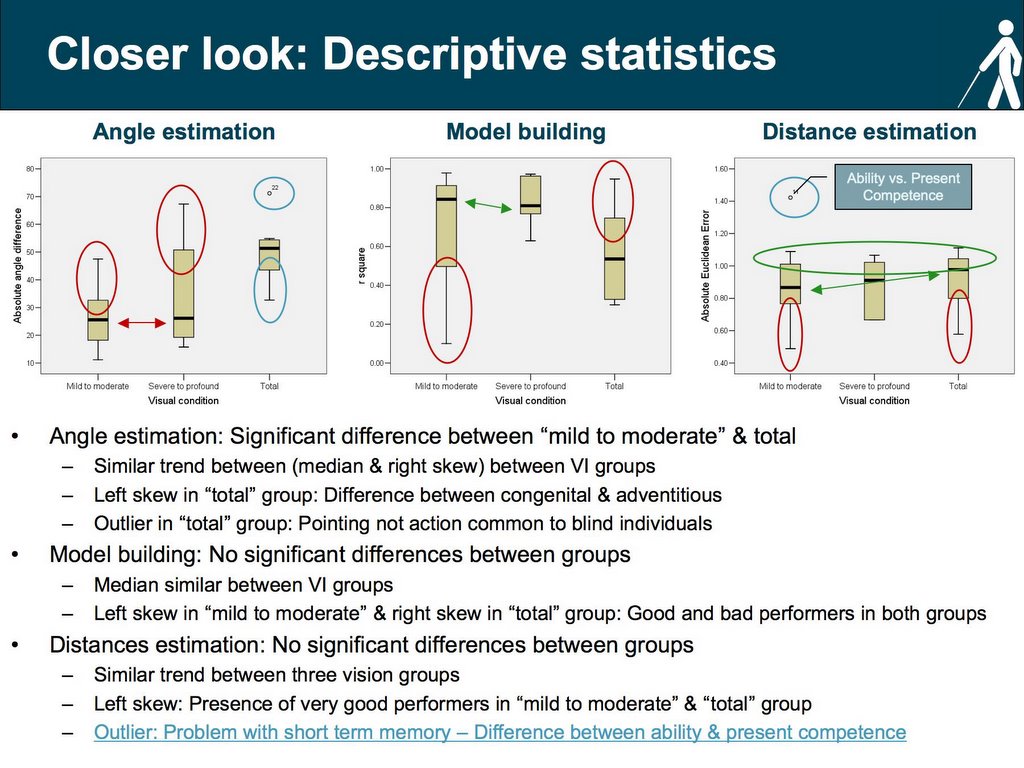
The “five number” summary of a data set consist of the minimum, the maximum, lower quartile, the median, the upper quartile and the maximum. It is essential for the researcher to know and report these values along with the standard deviations. A box plot is a visual display of the “five number” summary. They are particularly useful when viewed side by side and used to compare data from different groups (Tukey, 1977). The median is the line that runs across the box. The box itself stretches from the lower hinge (25th percentile) to the upper hinge (75th percentile). The lines that stretch out of the box are known as whiskers and they indicate the minimum and maximum data values. Points located beyond the whiskers (on either side) are the outliers. If the median line is not equidistant from both hinges the distribution is skewed. In a positive (right) skewed distribution the mean is larger than the median. In a negative (left) skewed distribution the mean is smaller than the median.

A good knowledge about the characteristics of a distribution can also inform the researcher about the value of the test conducted. A linear regression examines the relationship (or degree of fit) between two ordered variables. A scatter plot is usually constructed in order to visualise the data. This will allow the researcher to determine the appropriateness of the linear model and detect any departure from linearity (Smith & Prentice, 1993). In a least square regression a line is plotted where the sum of the squared distance of the points is a minimum. However, in a least square regression (the most commonly used method) an outlier can have a strong impact in the final result of the regression.

The median-to-median line (or resistant line) is a line through the data that is least affected by outliers and is an attractive alternative to the least square regression. In the resistance line technique no single point on the sample has a special influence on the projection of the line. Details for the calculation of resistant lines can be found in Velleman & Hoaglin (1981). Finally, there are several diagnostic tools for the evaluation of the adequacy of regression models (leverage, Cook’s distance, residual) and these are included in most statistical packages. Reporting Cook’s distance is particularly useful as it provides an index of the actual influence of each case on the regression function.

Sunday, February 12, 2006

The three classics

Past research has compared the development of children with visual impairment to that of sighted children of the same chronological age. Early research found that in the absence of disabilities children with visual impairment or blindness generally follow the same developmental sequence as sighted children. However, although these children reach the same developmental bench marks they tend to do so at a slower rate even if provided with the correct support and training (Ferrell, 2003).

We shall now look at three classic studies, significantly sited in current research, that have used this comparative approach.

Norris et al., (1957):


Longitudinal study between 1945 and 1952 that sought to establish developmental norms for children with visual impairments. The sample consisted of 295 children sixty of which were studied intensively under supervision of psychologists, social workers and the project staff. All the children had no additional handicaps aside from blindness although 85% were premature babies which subsequently developed retrolantal fibraplosia (current name: as retinopathy of prematurity - ROP). Intelligence, sensorimotor and social development were assessed with the Cattell Infant Intelligence Scale, the Interim Hayes-Binet Intelligence Test, the Kuhlman Scale of Intelligence and an adapted version of the Vineland Social Maturity Scale (Ashcroft, 1959). The researchers also gathered information on the level of mobility, medical factors, and created a prognostic rating scale to estimate the child’s potential for optimal development and future functioning (Warren, 1994). Finally, a rating scale was created to assess the influence of environmental characteristics and the child’s opportunities for learning. That is, the impact of the family and environment on the development of the child’s motivation and independence. The scale measured the family’s capacity to meet the child’s basic needs (especially those related to their visual impairment), family stability and their reaction to their child’s condition.

Results from the Cattel Infant Intelligence Scale revealed that the blind children took longer to achieve certain developmental milestones particularly motor skills (fine & gross), perception and perceptual motor integration. (Ferell, 1986). Lack of vision was also found to limit awareness of space and spatial relationships (Chess & Gordon, 1984). Fraiberg (1977) notes that only 50% of the blind children from the Norris et al., intense group were independent walkers at twenty-four months. This is a considerable lag if compared to sighted children who typically begin walking in their first year. A delay was also observed in the awareness of object permanence.

According to Warren (1994) one should be careful when interpreting these results given that no age correction for prematurity was used to control for the ROP subjects. He argues that if a three month correction factor is applied most motor and locomotor tasks fall within the age appropriate norm. The same is true for language development where the blind children showed a developmental lag when compared to the Catell norms but these differences diminish if a correction for prematurity is applied.

Several conclusions can be derived from this study. There was no significant correlation between degree of functional vision and any of the other measures except level of mobility. Overall, the development of the children in the “intensive” group was approximately equal to that of the sighted control. More important however, was the fact that “favourable opportunities” for learning were seen as the fundamental determinant of the child’s functioning level. Opportunities for learning can be understood as the stimulation necessary to elicit appropriate development. Providing the right environment and education at the appropriate time was more important than the degree of blindness, measured intelligence or the socioeconomic status and education background. The authors also suggest a “geometrical effect” to explain developmental delays. That is, the achievement of developmental milestones (or the skills that categorizes this milestone) is related to the time the child is ready to learn and when the opportunity to learn is provided. The authors conclude there was no relation between brain defect and ROP and that no specific mental deficiency could be directly attributed to blindness. The study is also one of the first to report that there was a considerable range of individual differences. That is, some of the children in the intensive group were on par (or sometimes advanced) with sighted developmental norms while others were not.

There are however a few methodological problems associated with this research. As noted above the subjects were chosen on the basis of no additional handicaps. This allowed the researchers to conclude that on the absence of mental or neurological deficiencies individual differences can be related to contrasting environmental circumstances. In a series of subsequent evaluations (Cohen et al., 1961; Cohen et al., 1964; Cohen et al., 1966) it was found that many of the participating children revealed patterns of neurological abnormalities.* The studies also revealed significant differences in intelligence scores. The authors have also been criticised for an uneven population where approximately two-thirds were females and the fact that the pre-testing level of intelligence for children in “intense group” was considerably higher than those in the control group. Finally, results should be carefully considered given the prematurity factor of the individuals blinded from ROP even with the proposed age corrections.

*One should be cautious when associating the concept of abnormal brain activity and brain damage especially when comparing a visually impaired population to a sighted control. Differences in brain activity (electroencephalogram and the attenuation or absence of alpha activity) are expected in situations of restricted sensory input.


Maxfield & Fjeld (1942) and Maxfield & Buchholz (1957):

Researchers have a used a variety of standardized scales to measure social development and adjustment of children with visual impairments. These are diagnostic tools but can also provide important information on the developmental norms of this population.

The Vineland Social Maturity Scale (Doll, 1930) was designed as an indicator of social competence, self help skills and adaptive behaviour for sighted children from infancy to adulthood. The scale consists of 117 items divided in the following categories: daily living skills (general self-help, eating, dressing); communication (listening, speaking, writing); motor skills (fine, gross & locomotion); socialization (interpersonal relationships, play, leisure and coping skills); occupational skills and self direction.

Maxfield and Fjeld (1942) adapted the Vineland scale for children with visual impairments. This became known as the Maxfield-Fjeld (MF) scale. The adapted version allowed for comparisons with norms for sighted children and to uncover specific areas in which the visually impaired are developmentally delayed. The scale avoided the measurement of intelligence, personality, habits, skill and focused instead “on the composite capitalization of such abilities for socially significant behaviour” (Maxfield & Fjeld, 1955, p. 2).

It is important to differentiate between intelligence (IQ) and social maturity tests. Warren (1984) notes that intelligence tests are designed to assess intellectual potential while the social quotient (SQ) in the social maturity scale is representative of actual performance rather than potential. This is of particular relevance in this research given that it will be argued that performance in spatial tasks is an indicator of present competence not ability or “capacity to do”. Several researchers (see Warren, 1984 p.226) found significant correlations between the two measures.

The MF scale consisted of 77 items classified under several categories (general, eating, dressing, locomotion, occupation, communication, self-direction and socialisation). Scores are presented in the form of a social quotient (social age/chronological age x 100). The children in their study ranged from nine months to seven years and varied in terms of mental ability (3 categories: superior, normal & retarded) and functional vision (total to minimal).

Maxfield & Buchholz (1957) revised the MF scale and applied to 484 children that varied in functional vision their age ranging from five months to six years. It should be noted that like the Norris et al., (1957) study the majority of these children (60%) were blind due to ROP . The majority of the remaining children suffered from cataracts or optic atrophy. The study’s main aim was to inventory the social development of children with visual impairment based on the general performance of other visually impaired children of the same chronological age (Ferrell, 1986). That is, a social maturity scale normed on blind children.

Several results emerged from this research. First, it was found that the social quotient of the blind and visually impaired children (as a group) was considerably lower (mean VI = 83.54; mean sighted = 100). It should be noted however, that there was a great deal of variation within the visually impaired group with SQ scores ranging from 26 to 163 with a standard deviation of ± 29.28. In addition, the authors did not find any significant differences in the development of locomotion when compared to the sighted children. This results differs from Norris et al., (1957) who found considerable lags in crawling and walking.

Maxfield and Fjeld also compared SQ scores of the total blind with those of the visually impaired. They found only marginal differences between these groups with the visually impaired scoring higher. Here again they note that the “difference is not statistically reliable since the groups are small and the variability [is] great” (Maxfield & Fjled, 1942, p. 12). The authors conclude that the blind tended to be more docile, lack initiative, are less active and introverted.

Closer analysis revealed that health, early intervention, specialized training and environmental stimulation were among the most important factors leading to a higher a SQ in the blind and visually impaired children. Specialized training is of particular importance an this was obvious from a rise in the SQ of during the testing phase. They conclude that if the visually impaired is stimulated to take an interest in the environment a desire to dominate it will develop in much the same manner as the seeing child.

Finally, the authors are quick to point that given the complexity of the problem, it is doubtful that any single diagnostic instrument is sufficiently adequate to measure the development of the visually impaired. The scale should be used as a guide and not as an absolute measure. The same amount of caution should be used with the age norms given the size of the sample and the amount of diversity among the children.


Fraiberg (1977):

Fraiberg studied the development of ten congenitally blind babies some of which had minimal light perception. This was a 15 year longitudinal study tied with an educational program summarized in her book Insights from the Blind (1977). The babies entered her educational program from ages one to eleven months and were neurologically intact with no additional sensory or motor disabilities. The purity of the sample allowed for inferences to be made about the role of vision in the development and organization of sensory abilities. An in depth review of her work is beyond the scope of this thesis. However, we shall outline some of her major findings in the area of prehension and gross motor development and their implication for a developmental theory of the blind.

In the area of object prehension, she observed that prior to entering the educational program 7 out 10 of her subjects made no “gestures of reach for persons or toys at tactile remove even when voice or sound cues [were provided]” (Fraiberg, 1977, p. 275). In her educational program she argues that vision usually lures the child to discoveries and she encourgaes parents to create exchanges and experience to arouse interest and maximally engage the child with the environment. She notes however, that despite the program’s effort, the blind infants were still developmentally delayed. She attributes this lag to the difficulty the blind infant has with the concept of object substantiality and spatial unity.

In the area of gross motor development she notes that typically the postural attainment of the blind infant were within the norms of the sighted. However, the consequent mobility items (that follow each postural attainment) were considerably delayed falling outside the sighted ranges. Here again, she argues that blindness acts as an impediment to adaptation that restricts “environmental lures” that would initiate locomotor development. Fraiberg regarded the development of an object concept as critical. It is only after the attainment of the concept of object permanence (constancy) that the child is able to confidently let go of the object (or person) and explore the rest of the environment (Warren, 1984). In addition, the absence of stimulation is also associated with a delayed formation of a sense of security and the retardation exploratory behaviour (Warren, 1984).

Her educational program urged for an enhancement of the ties between parents and children and warns of the retarding effects of parental over-protectiveness. Fraiberg puts forward several reasons why her findings should not be generalized to the blind population. She notes that the “blind” population encompasses individuals with a varying amount of useful vision. This is coupled with a high incidence of brain damage and other associated handicaps. Furthermore, the age of onset impairment should also be considered given that many blind individuals have lost their vision after crucial developmental stages.

Monday, January 23, 2006

Snooker Masters 2006


A perfect day @ Wembley!! Yes, I know Ronniw did not win... but hey we met Steve Davis & John Parrott.

Click on the picture to enlarge.
Click on the link to see the rest of the photos: Snooker photos

Monday, January 16, 2006

CASA Seminar notes

I am putting my last seminar along with some notes online. This sums up where I stand in my research and what I hope to accomplish in the next eleven months before submitting my thesis.

A few words on the seminar:

The Centre for Advanced Spatial Analysis hosts a weekly research seminar. Students are given the opportunity to present their latest results or any form of progress. The slides and notes are part of my third and last seminar - I am also planning to put the first two seminars online. Many of the slides include animations and movies. To view please click on the hyperlinks (blue underline - please allow a few seconds for the video to load). The animations and movies will also be described in the notes. Finally, the notes are somewhat choppy and at times simplistic especially when it comes to reviewing material that was presented in the past seminars. Please feel free to comment and critique.

Slide 1 - Spatial representation & low vision: Two studies on the content and accuracy of mental representations of individuals with a visual impairment or blindness


In my first seminar (over 2 years ago) I discussed the development of spatial knowledge and presented several examples of research on the representation of space by individuals who are sighted, visually impaired and blind. I traced the trajectory from Piaget and his critics to the work conducted by Golledge and others at the Santa Barbara School. I presented results from different studies in Europe with special attention to those conducted by Kitchin, Jacobson & Ungar in the United Kingdom and Thinus-Blanc & Gaunet in France. I presented and explained the three theories described by Fletcher (1980) and argued with some arrogance but I think with enough evidence that the majority of the research conducted in the 90’s worked to fit this three-theory model. Finally, I introduced the re-weighting theory - a more recent and elegant approach to the development of spatial knowledge proposed by Newcombe & Huttenlocher (2003). The seminar concluded with some of the methodological problems related to this type of research.

In my second seminar I introduced the two experiments that I planned to conduct at the Royal London Society for the Blind. I explained how one experiment would test the content and accuracy of mental representation in a known environment while the second would to the same for a new and complex environment. I also mentioned that the second experiment would concentrate on the exploratory strategies used by individuals when faced with an environment for the first time. In the same presentation I discussed the methods I used to collect the data and highlighted the importance of multiple tests when dealing with population that is extremely heterogeneous like the blind and visually impaired. I concluded by framing my approach to Gibson's perception action cycle and phenomenology – By phenomenology I mean the manner in which the individual actively constructs his reality through experience.

In this presentation I will present the results from the first experiment and show how far I’ve got in the second experiment. More important, I plan to convince you of two things: 1-That individuals who are blind or visually impaired are able to construct gestalts of their environment. In other words, that these individuals are able to achieve a configurational (or Euclidean) knowledge of their environment and are able to represent geographic concepts such location, distance, direction and overall configuration. 2-That there is a very important need to recognize and differentiate between ability (possessing the quality to perform) and present competence (the actual performance).

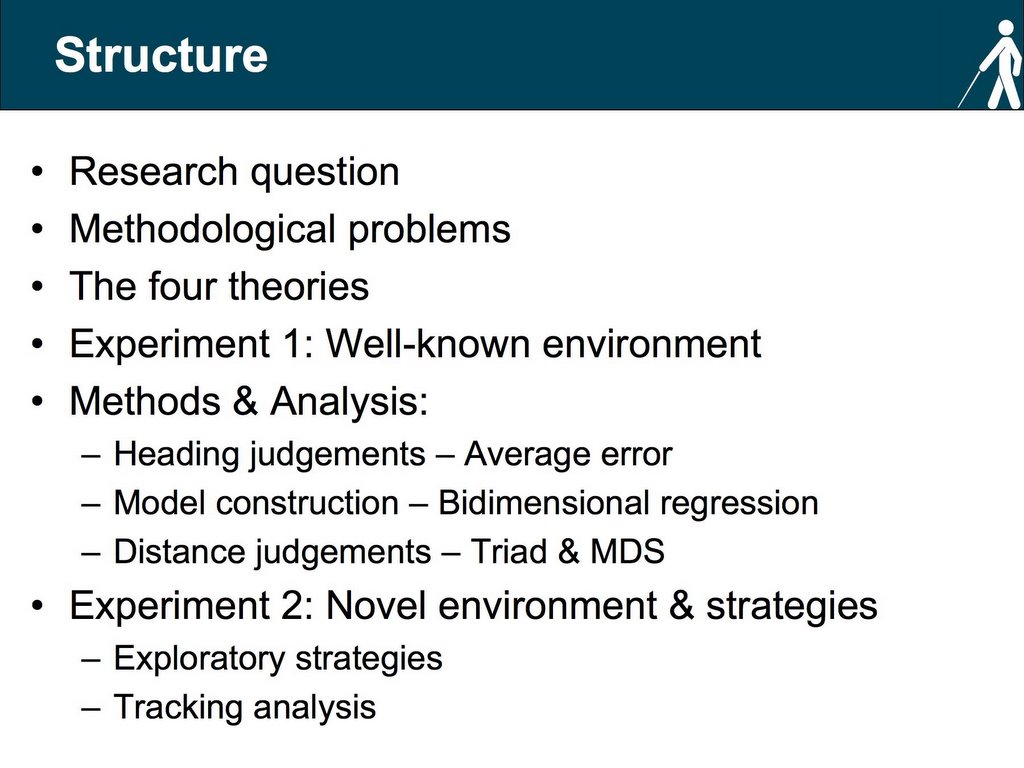
Slide 2 - Structure


A few words on the structure of the presentation:

I’ll begin by presenting my research question. Very quickly I’ll go through some of the methodological problems associated with this type research. Next, I’ll review the three theories and introduce a 4th theory – the amodal theory. I’ll then move to the first experiment (the one testing the content and accuracy of mental representation of a well known environment) and present the results for the three tests. I’ll then discuss these results and link them to the second experiment. As I’m still gathering the data, I will explain the rationale for the experiment along with some examples.

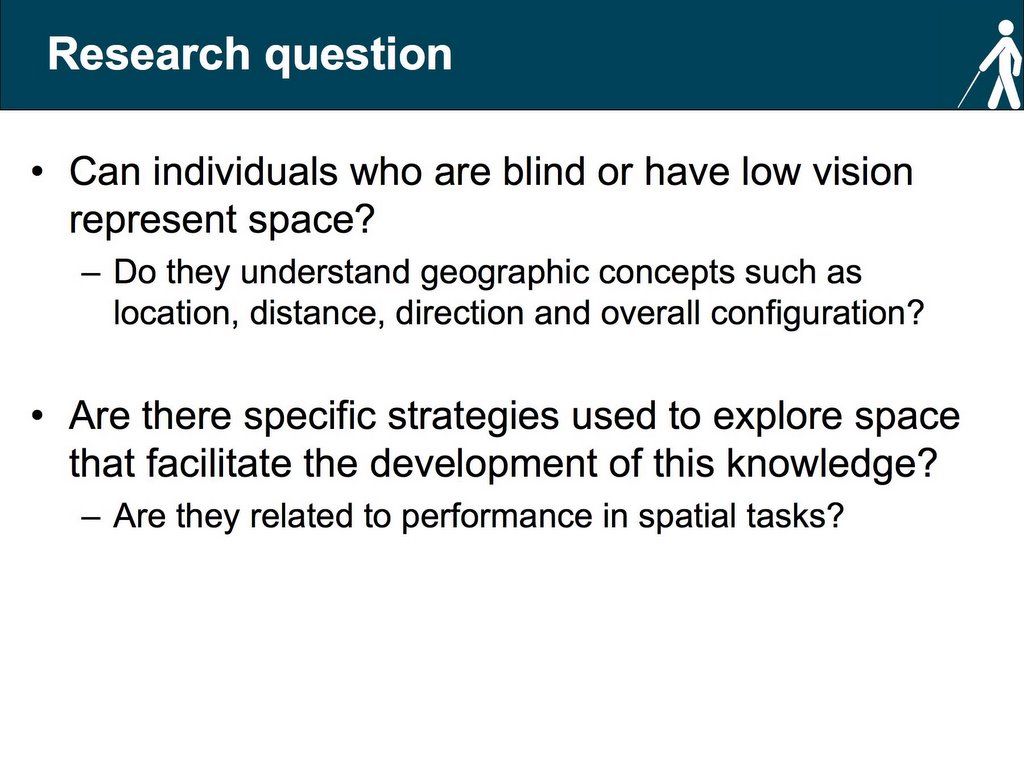
Slide 3 - Research Question


This slide is self-explanatory and presents the two research questions and the rationale for both experiments. The second question is of particular interest as it opens the way for a different approach to understand individual and group (early blind, late blind, mild-moderate VI, severe profound VI & sighted) differences in the development of spatial thought.

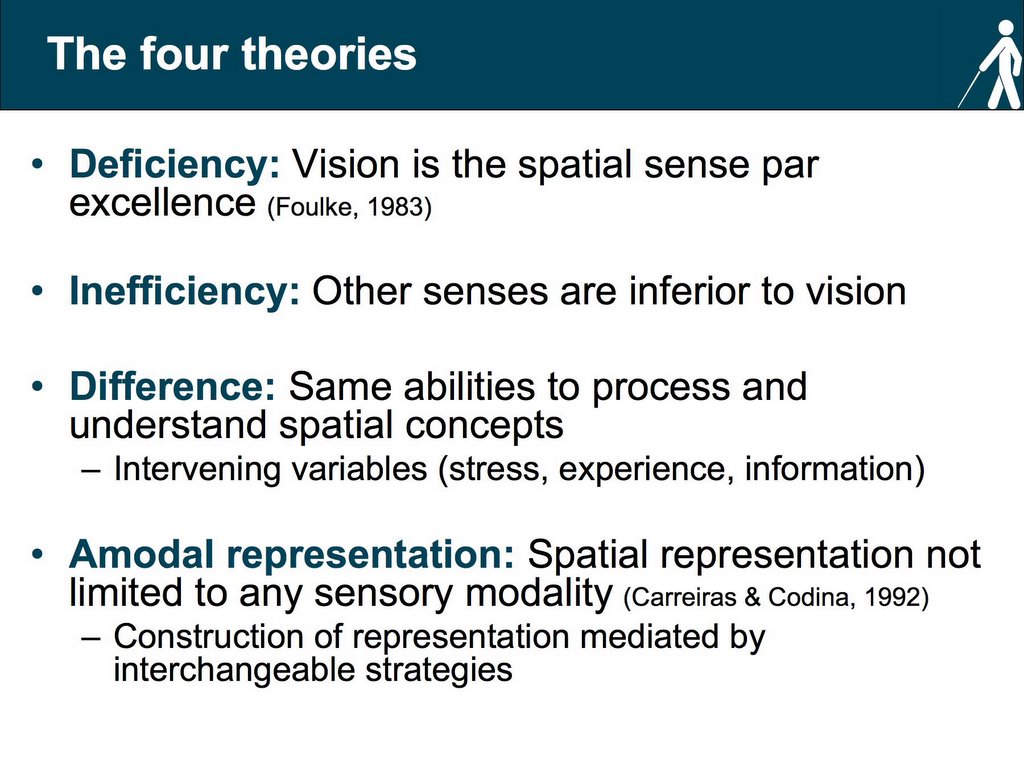
Slide 4 - The four theories


In my first seminar I presented a variety of studies and framed these within the three theories developed by Fletcher (1980). In my second seminar I added another theory by Carreiras & Codina (1992). For now, I’ll just present a quick review of these theories. Details and examples will be available when I put the two other seminars online.

Deficiency: This theory holds that vision is essential for the formation of mental representations. This is an extreme view that has very few supporters and can be said to originate in the work of the German doctor Marius von Senden (1932). After reviewing a series of cases of individuals that recovered from early or congenital blindness (removal of cataracts) von Senden noted that “…the blind can only grasp succession and relation [unable] to produce the completed whole” (von Senden, 1932: p. 288). In other words, vision is the spatial sense par excellence (Foulke, 1983). That is, the early and congenital blind are not able to build overall impressions from fragmentary experiences of the environment collected by the other senses. They are incapable of spatial thought, as they have never experienced the perceptual process necessary to comprehend spatial arrangements. Fletcher (1980) has argued with considerable success that the blind can form gestalts from sequentially perceived information providing evidence from photographs and sculptures by blind artists where different parts of the work are integrated to form a whole.

Inefficiency: The inefficiency theory holds that the other sensory modalities are inferior to vision. That the blind and visually impaired are able to manipulate spatial concepts but that their mental representations are substandard or incomplete when compared to the sighted. Auditory, kinaesthetic and haptic cues are less effective ways of encoding spatial information. Support for this theory is originally found in the work Worchel (1951). Worchel conducted two experiments: The first was a mental matching experiment where congenitally blind (C. blind), adventitiously blind (A. blind) and blindfolded sighted subjects were given two objects (in each of their hand). After feeling and playing with the objects they had to choose (from a set of objects on a table) which object represented a synthesis of the two forms. He found that the performance of the congenitally blind, although above chance, was inferior to that of the adventitiously blind. Moreover, the performance of both blind groups was inferior to that of the sighted. In the second experiment he led subjects along two short legs of a triangle and asked them to return along the hypotenuse. Here again, the sighted performed better than the two blind groups as the congenitally and adventitiously blind made more errors of distance and direction. Echoing the words of Revesz (1933) Worchel denied, “that it should be possible by haptic perception alone to get a homogeneous idea of the form of objects.” There are a series of modern experiments that support this theory and these will be presented when the first seminar is put online.

Difference: The difference theory holds that the spatial abilities of the blind and visually impaired are functionally equivalent to the sighted. They have the same abilities to process and understand spatial concepts but these are developed more slowly and by different means. Jacobson (1997) notes that “lack of vision slows down ontogenic spatial development…but does not prohibit it.” In this manner differences can be explained in terms of intervening variables such as stress, experience and access to information. Juurmaa (1973) notes that one should be careful when interpreting Worchel’s results as these may be flawed and based on a testing artefact. He argues that subjects were dealing with material (triangles or other geometrical forms) that was optically familiar. Differences between groups disappear when asked to synthesize irregular shapes or return to the starting point after being guided through and irregular shaped path. This theory is sustained by the idea that the haptic frame of reference develops more slowly than the visual.

Amodal: This theory will be discussed throughout the presentation and will only briefly presented here. It was first proposed by Carreiras & Codina (1992) and questions the central role of vision in spatial cognition. That is, spatial representation is not limited to any particular sensory modality although processing is probably faster with vision. This theory finds support in work of Susana Millar (1994) as she notes that vision is neither necessary nor sufficient for spatial coding. In her work she presents a theory of overlapping inputs necessary for the coding of space. Finally, this theory allows us approach the construction of mental representations as a result of interchangeable strategies used to explore and understand space.

Slide 5 - Methodological problems


There are a series of methodological problems (more like inconveniences) associated with this type of research and these were discussed in detail in my first seminar. They can be divided in two sections: 1-Problems related to the experimental design. 2-Individual factors.

1-Experimental design

1.1-Incompleteness of mental representations: One must be careful when interpreting the absence of phenomena (elements) in mental representations. In perhaps one of the best criticisms of Kevin Lynch’s work, Downs & Stea (1973) note that although many of the subjects failed to account for the John Hancock building it is hard to believe that as Boston residents they did not know about its existence. It is important to differentiate between denotative and connotative meaning. That is, lack of connotative meaning (no significant role) is different from lack of awareness.

1.2-Inferential tasks are more difficult: Tests that require the transformation of an image are harder to complete than tests that involve the recall or recognition (spatial memory) of elements. One should be careful when interpreting and comparing results between different experiments.

1.3-Size of space is an important factor in performance: The layout, size and spatial complexity of the space will produce different results. Some authors (Byrne & Salter, 1983; Dodds et al., 1982) have reported more errors in large spaces while Ochaita & Huertas (1993) argue that performance is mainly a factor of the level of complexity not the size of the space. Again one should be very careful when comparing and generalizing results.

1.4-Size of groups under study: The percentage of the population that is congenitally blind is considerably low (not so much the case for adventitiously blind or visually impaired) and at times statistical tests are performed on small sample sizes. In an extreme case, Spelke (1981) based her results in the performance of one blind subject. Researchers should be encouraged to use larger sample sizes or at least report obvious but essential statistical data such as standard deviations and distributions.

1.5-Numbers of elements to process: Is performance related to spatial ability or to memory and attention? Researchers should differentiate between recall and recognition tasks and be aware of the group’s average capacity (how many?) to mentally store elements. Furthermore, short-term memory suffers from a decay effect that can influence spatial memory tasks. It is important to distinguish the critical times for testing and make sure that all subjects are tested with the same delays.

1.6-Nature of response: Siegel and Cousins (1985) have argued that one should be cautious when interpreting the results from tests that involve an externalization of mental representations. Different tests can generate different results given that the participant’s responses are re-representations of the environment. That is, each type of externalization (verbal, pointing, orienting, sketching, or the construction of models requires specific mental computations that are bound to generate different results (Siegel, 1981). Multiple converging techniques should be used to better understand and interpret results from spatial tests.

1.7-Level of familiarity with the experimental design: Experience can have a considerable effect in the content and accuracy of mental representations. How do we account for the level of experience? When do we consider an environment to be familiar? How do we measure experience with the testing procedure? These are just some of the questions the researcher must take into account before designing the experiment.

1.8-Mode of collection of information: There is a big difference between being the passenger and the driver. Many of us have experienced the awkwardness of getting lost when having to reach a destination visited many times in the past when someone else was driving or guiding us. Experiments should clearly indicate if the collection of spatial information was active or passive (guided vs. free exploration) as this can influence the type and amount of information collected.

2-Individual factors

2.1-Type of impairment: Warren (1984) warns about some of the problems when comparing blind, partially sighted and sighted subjects in different spatial tasks. It is hard to classify a population that is extremely heterogeneous. This problems is further complicated given the evidence supporting the variability of individuals with the same eye condition. Individuals can vary in terms of their eye condition, visual acuity and/or field. Some researchers have argued that certain eye conditions have a larger effect on performance. Loomis et al., (1993) found that the performance of individuals with retrolental fibroplasias was significantly inferior when compared to the other VI groups. Dodds et al., (1991) found no such relation.

2.2-Age: What criteria should be used to distinguish the early from the late blind? Researchers from different fields vary in their interpretation of the critical age. For the developmental psychologist it is usually when the infant starts to coordinate movement with vision while for the neuropsychologist this is related to the development of the brain, which reaches its full maturity only after puberty. This has led to different classifications. Rieser (1992) classified as early blind those affected during the first three years, Herman et. al., (1986) until the first year while Millar (1979) before 20 months. In addition, it is important to distinguish static from progressive conditions. This is of particular importance in repetitive or long terms studies.

2.3-Level of education & intelligence: Several studies (Thinus Blanc et al., 1999) have cleverly matched participants in terms of their IQ. Spatial tasks can involve complex mental calculations and performance may be related to the level of education or intelligence.

2.4-Level of orientation and mobility: Many spatial tasks involve learning the location of elements along a route. Good orientation and mobility skills play an important role in the coding and construction of the mental representation. Mobility instructors teach different strategies when walking in familiar and unfamiliar environments and these can prove beneficial during the testing phase.

2.5-Affective development: Confidence and quality of life can also affect performance and researchers should control for the emotional state of the participants. Studies have identified that sudden (accident) or late loss of the visual field is usually associated with depression and difficulties in rehabilitation.

Slide 5.1 - Different visual conditions


I don’t particularly like this slide as I think it is almost impossible to simulate a visual condition (represent graphically what one can or cannot see). The slide however, allows us to demonstrate that there is a significant difference between conditions and this can lead to considerable problems if all are grouped under a “visually impaired” heading. In a recent working paper I discuss a hypothetical case of two subjects; one with retinitis pigmentosa (RP) the other with severe myopia and highlight some of the problems in the testing and classification of these individuals. “Take for example a subject with RP who has poor night vision and happens to be tested during the day. While still impaired due to a restricted visual field (Kanski et al., 2003) chances are that his performance will be significantly different in a situation with low light. How can this individual be put in the same group with someone with severe myopia whose condition does not significantly vary in relation to lighting changes?” (Schinazi, 2005)

Slide 6 - Experiment 1: Royal London Society for the Blind Campus


The slide illustrates a simplified model of the Royal London Society for the Blind campus. This is the setting of the first experiment that will test the content and accuracy of mental representations of a well-known environment. Blind and partially sighted students were guided along a route (blue dotted line) and were asked to remember the location of ten places (8 buildings, 1 fountain and 1 shed). Before walking the route the students were briefed on the research and told what type of tests they should expect to complete. They were also told to think about the actual and relative position between the different places. The testing phase started directly after they finished walking the route.

Slide 6.1 – Visual range


As mentioned above, we are dealing with an extremely heterogeneous population and grouping subjects solely in terms of their visual condition/state can lead to several statistical errors. Researchers should be aware of individual differences and look at different ways to classify visual impairment. In my opinion, a complete study will include different forms of classification (visual acuity, visual field, type of condition and performance) and a discussion of their difference. For the first experiment subjects were classified in terms of their visual acuity. Three groups (mild to moderate visually impaired; severe to profound visually impaired and blind) were created based on a visual range chart proposed by the International Council of Ophthalmology. I am now working to classify these individuals in terms of their actual condition and separate between the congenitally and adventitiously blind. I plan use the same format for the second experiment. In addition, I will introduce a form of classification in terms of performance. This form of classification was first proposed by Hill (1993) and allows for the study of the strategies used to explore space and construct mental representation. I will also argue that this approach allows us to bypass some of the pitfalls related to the heterogeneity of subjects.

Slide 7 – Angle estimation


For the first test students were asked to make pointing judgements using a digital compass. Before the test students were taught how to use the compass and given a few minutes to familiarize themselves with the testing procedure. They were asked to make several pointing judgements (45 in total) from the different locations identified along the route. An accuracy score was generated by calculating the difference between the real and estimated angle.

There has been some discussion as to the relevance or significance of using “absolute error scores” in this type of testing. Montello et al., (1999) note that while it is true that we should also account for constant and variable error, absolute error is probably the best measure of performance, as it requires a low constant and variable error. They argue “one would not consider a person to have high spatial ability if he or she had a large bias (constant error) in pointing to targets but little variability around this biased pointing directions. Nor would a person be considered to have high ability if [the] estimates are always centred on the correct direction but were highly variable.”

An analysis of variance (ANOVA) was conducted and a significant difference in performance was found between the vision groups. A Tukey’s honestly significant difference test (TUKEY HSD) revealed that the difference was between the mild and moderate visually impaired and the blind group (F(2,21) = 5.878, p ≤ 0.009). The three graphs at the bottom of the slide are scatter plots for each vision group. The x-axis represents the real angle and y-axis the group’s estimation. This is just another way of representing the results (goodness of fit). Here we can easily identify a “growing spread” related to the severity of the visual condition.

At first, these results seem to make sense and several researchers have discussed the spatial abilities of the blind and visually impaired based (sometimes solely) on this type of test. However, it is important to note that pointing is not action commonly undertaken by blind people. In my first presentation I discussed in some detail the advantages of vision. For now, it would suffice to say that apart from the ability to quickly form gestalts (wholes) vision allows for the instantaneous collection and assembly of distal information.

Here I would like to go back to what I mentioned in the introduction about the importance to differentiate between ability and present competence. A research that aims to study the spatial abilities of the blind and visually impaired which solely tests individuals in pointing tests does not allow for this distinction. The fact that blind people are not accustomed to point and will have a greater chance of performing at a lower level (greater absolute error) does not mean that the content and accuracy of their representation is substandard. Pointing tests do not allow for the correct externalization of the representation, as blind have different strategies to collect and process distal information. In this manner, a lower performance is related to a testing artefact not the actual spatial ability. This point will be further discussed when the results from the other tests are presented.

Slide 8 – Model: Bidimensional regression


The next test consisted of building a model of the campus. Model building is an effective way to test for configurational knowledge as it forces the individual to represent the allocentric relationships between the different locations in the campus. Students were asked to complete a cued model. Spatial cued models provide the subject with scale and orientation minimizing the motor skill component. Ten three-dimensional card pieces representing a scaled version of the locations were created. Three were placed on their real cartographic location on a gridded (1cm X 1cm) magnetic white board. Students were asked to position the remaining seven pieces in relation to these.

Results were analyzed using bidimensional regression (Tobler, 1993). A bidimensional regression is essentially a regression for a pair of coordinates. It statistically calculates the degree of association (r2) between two configurations of related coordinate data (Kitchin, 1993). It measures the fidelity in terms of scale (φ), angle (θ) and horizontal & vertical translation (α1 & α2) between where a place is in reality (referent coordinates) and where the subjects thinks it is (variant coordinates). Comparisons are be made by calculating the average r2 for the group. The r2 ranges from 0 to 1 with a higher degree of resemblance as the score approaches 1. Waterman & Gordon (1984) have proposed a distortion index (DI) to measure the overall distortion of the representation after all systematic transformations are performed. Lloyd (1989) notes that this can be thought as a standardized measure of relative error. The distortion index ranges from 0 to 100 (inversely related to r2) and is a dimensionless value. The DI has been substantially reviewed by Friedman & Kohler (2003) who proposed an elegant alternative for calculating distortions without disrupting the relationship between the dependent and independent variables in a regression. The main error associated with Waterman & Gordon (1984) algorithm is that the variants coordinates are always assigned the role of independent variable. For the purpose of this presentation it will suffice to look at the r2 value. A distortion index is still presented but this was calculated with the Friedman & Kohler (2003) algorithm.

Slide 9 - Bidimensional regression: Example


The slide presents the results of a bidimensional regression for two subjects. Subject 9 (left) is blind (retinopathy of prematurity) and subject 16 (right) is part of the mild to moderate visually impaired group (retinitis pigmentosa). Please click on links to open a new window with a video of the subject constructing the model. The performance of both subjects was above chance although the blind subject performed better (r2 closer to 1) than the visually impaired. The graphs below illustrate the position of the real (blue circle), estimated (green circle) and given/fixed (pink circle) of the 10 different locations and allows for a visual representation of the distortion and r2 values. The lists to the right of graphs present the value for the scale, angle and translation changes.

Subjects were divided in three groups (same as in the first test) and an average r2 value was calculated. An analysis of variance (ANOVA) was conducted and no significant difference was found between the three vision groups (F(2,21) = 1.442, p = 0.259). That is, there was no effect of vision in the representation of space when externalized in the form of a cued model. The mean value for the three groups (mild to moderate: 0.68; severe to profound 0.86; blind 0.56) is of particular interest and provides constructive evidence on the ability of this population to represent space. Finally, the outstanding performance of the severe to profound group (average r2 = 0.86) fits with Millar’s (1994) overlapping input theory. That is, these individuals were forced to use to a greater extent a combination of both visual and propioceptive information in order to code space. It is clear that this form of overlap is also present in the other two groups although for the blind and mild visually impaired groups coding may be favoured by a specific modality. In the case of the blind coding is favoured by proprioception while for the mild to moderate visually impaired it is mainly based on vision. We will go back to this discussion when the statistic details of the tests are presented.

Slide 10 – Distance triad: Explained


The last test consisted of estimating distances. Past research has identified that people are not good with exact metrics when asked to make distance estimations. For this reason, a lambda 4 balanced incomplete block design (Burton & Nerlove, 1976) was used to generate a triad questionnaire. This type of data collection has been used with considerable success in the past in similar experiments (Ungar et al., 1996). In this case, subjects were given different sets (60 in total) with three locations visited during the route and asked to estimate which pair of locations is the closest together and which pair is the furthest apart. The questionnaire is scored in the following manner: The pair judged closest is given a score of ”0”, the pair judged furthest a score of “2” and the remaining pair scores “1”. In a lambda 4 design each pair of locations appears four times. This means that the total score for the pair can range from zero to eight. Next, the exact metric Euclidean (straight line) and functional (route) distances are calculated (generated with ArcMap) and using the same questionnaire a score is generated. Errors are calculated by subtracting the estimated from the real scores. In this case you get two error scores (relative to the Euclidean and route metrics). Finally, results from the triad can be arranged into an ordinal matrix of dissimilarities to be mapped and analyzed using multidimensional scaling (MDS). Multidimensional scaling (Jacobson et al., 1995) is a techniques “that allows for a two dimensional representation of a pattern of proximities among a set of locations” (Schinazi, 2005).

Slide 11 – Distance triad: Results & MDS


An analysis of variance (ANOVA) revealed no effect of vision in the estimation of distances through triadic comparisons (F(2,21) = 0.038, p = 0.963). All groups performed at a relatively high level (mean error - mild to moderate: 0.89; severe to profound: 0.87 & blind: 0.90). As we shall see in the next slide this was the most consistent test across groups with individual errors centred around the mean without any major skews.

The two graphs below are the results of multidimensional scaling derived from the response to the triad questionnaire. Multidimensional scaling allows for the graphical visualisation of a matrix of perceived dissimilarities (see previous slide). The graph on the left is a representation of the location of the ten places visited along the route based on the triad/questionnaire completed with the exact Euclidean metrics. The graph on the right is a representation based on a triad questionnaire completed by a student in the mild to moderate visually impaired group. The two tables next to the graphs present the stress values for the scaling.

The main problem with MDS is that it is very hard to compare representations (graphs). This is because the MDS algorithm is concerned only with the relative proximities between the different elements (in our case the ten locations visited along the route) and does not account for their absolute position in space. What it does provide however, is useful information for a typological type of analysis as it is able to illustrate groups or clusters of locations. If you scroll back to the map of the RLSB campus (slide 6) you’ll notice that the campus can be divided in two sections: 1-The college area includes A-block, B-Block, Student Centre, Thomas Lucas and ELJ. 2-The school area includes the Mansion House, Nursery, School, Fountain and M-block. These two clusters can be seen in the Euclidean MDS (college area = red circle & school area = blue square). The same clusters can also be seen in the MDS derived from the triad questionnaire completed by a subject from the mild to moderate group.

Slide 12 – Closer look: Descriptive statistics


This slide is an essential part of my research as it links the two experiments conducted at the Royal London Society for the Blind. It is basically an analysis of the descriptive statistics for the three tests that were conducted. More important, it provides convincing evidence for the presence of good and bad performers in each group.

A few words on box plots

Box plots are an efficient method of displaying different aspects of a distribution (Tukey, 1977). They provide a “visual summary” of the median, upper/lower quartiles and minimum/maximum data values and are of particular interest when viewed side by side and used to compare data from different groups. The median (the middle of the distribution) is the line that runs across the box. The box itself stretches from the lower hinge (25th percentile) to the upper hinge (75th percentile). The lines that stretch out of the box are known as whiskers and they indicate the minimum and maximum data values. Points located beyond the whiskers (on either side) are called outliers. If the median line is not equidistant from both hinges the distribution is skewed. In a positive (right) skewed distribution the mean is larger than the median. In a negative (left) skewed distribution the mean is smaller than the median.

1-Angles estimation: If we look at the first box plot we are able to identify several important differences/similarities in the distribution of the three vision groups:

The median for the two visually impaired groups is about the same. Although there is a noticeable right skew in the “severe to profound” group there was no effect of vision in the estimation of angles for these two groups. A significant difference was found between the mild to moderate and the blind group. Looking at relatively high mean and median of the blind distribution, it can be argued that the positive skew (decline in performance) is a reflection of an effect of vision or as argued before the result of testing artefact that favours vision. The right skew also points to a considerable presence of bad performers in the “severe to moderate” group. Further analysis will determine if there is a relation between the level of performance and the type and age of onset impairment. Finally, given that there was no significant difference between the two visually impaired groups for this test (as we shall see the same is true for all tests) it can be argued that they are part of the same population and can be grouped (this will be done at a later stage) to form a mild to profound visually impaired group.

If we look at the box plot for the blind group the situation is reversed. Here we see a high median (high absolute error) with the vast majority of individuals performing at a low level. Moreover, while the distribution is negatively skewed pointing to the presence of a few good performers, the minimum whisker is still above the median for both vision groups. In this case a relation was found between performance and the age of onset blindness. Finally, we also note the presence of an outlier (subject # 22). It is worth noting that in the box plots for the other tests (model building & distance estimation) this subject falls within the distribution. This provides further evidence for the ability and present competence debate.

2-Model construction: In the box plot for the model construction test one can easily notice that although there was no effect of vision in the construction of the model, the distribution for the three groups is considerably different.

The box plots point to the presence of good and bad performers in the three groups. This type of data needs to be approached and analysed within the “individual differences” paradigm. This paradigm accommodates an amodal interpretation (vision neither necessary nor sufficient for spatial coding) of the data. The main objective lies in the identification/isolation of the reason behind the variability in performance within each group. In other words, what is causing some people to perform better (in some cases – much better) than others? We will get to this in the following slides – for now let us concentrate on remaining characteristics of the distributions in the model construction test.

Looking at the box plot for the “mild to moderate group” we note that it houses the best and worst performers for all three groups (look at high and low whiskers). Although the median is relatively high the left skew (group mean lower than the median) points to a considerable presence of bad performers. In the “severe to profound” group we note that although the median is slightly lower when compared to the “mild to moderate group” the distribution is characterized by a positive skew (mean larger than the median). Overall, this is the best performing of the three groups where even the lowest performer (lower whisker) falls well within the distribution of the two other groups. The box plot for the blind group shows a normal distribution (median and mean about the same). However, when compared to the two other vision groups, the 25th percentile of the distribution is the lowest and the 75th percentile falls below the median of the two other groups. At the same time, the high whisker points the presence of a very good performer.

3-Distance estimation: The box plots for the distance estimation task shows a similar trend for the three vision groups. In this case, the median for the three groups is relatively the same and although the three distributions are skewed the mean and median disparity is not as acute as in the other cases. Although the best performer is in the “mild to moderate group” (low whisker), the negative skew in the “severe to profound” and “blind” groups point to the presence of good performers. It is also worth noting the presence of a very good performer in the blind group. As mentioned before, this is the test where overall performance (3 groups) was the highest (even if some subjects reported that this was the hardest test to complete).

What is the reason behind this good performance? I would like to argue that when completing the distance questionnaire subjects make use of a temporal dimension, which if not present is at least not as evident in the two other tests. That is, responses are weighted in terms of vision (in the case of the sighted or VI), proprioception (sighted, VI & blind) and a temporal element (how much time did it take to get from point A to point B). It is the combination of these 2 (sometimes 3) inputs, an overlap of cognitive dimensions, which facilitates estimations and provides more accurate answers.

Finally, we notice the presence of an outlier (subject 11) above the high whisker of the “mild to moderate” group. This brings me back to the ability and present competence debate (and the beauty of collecting ethnographic type data). A closer analysis of the video of this subject answering the distance questionnaire revealed that the subject experienced considerable difficulties when having to simultaneously retain the names of the three locations. While this subject’s performance in the previous tests was within the group mean both tasks did not require a constant referral to short term memory. The tests were conducted in a well-known environment and involved to a larger extent the use of and already internalized (long-term) representation. The distance estimation test also required the use of this internalized representation; however, the fact that it was verbally administered forced the subject to multi-task between short and long term memory.

Slide 12.1 – Ability vs. present competence


To conclude on the ability and present competence discussion two other tests were conducted:

1-Ranking: The scores of the different participants for the three tests were ranked. The bar graph indicates how subjects ranked differently (sometimes considerably different) depending on the task and highlights the need of multiple tests when comparing performance. In the following months, I plan to conduct a series of non-parametric tests in order to ascertain the significance of this relationship.

2-Test difficulty: Subjects were asked to choose which test they considered the hardest to complete. A chi-square test revealed that there was no preference among groups for any specific test (χ2 = 1.974, df = 4, p = .741). In other words, there was no agreement between groups as to the difficulty of the different tests. That is, what one subject in a particular group considered as an easy task was not always the case for the rest of the group.

Slide 13 – Explaining the difference: Mobility & LVQOL


The difference in performance between individuals in the same group (in the three tests) leads us to one very important question: What is causing some of the subjects in each group to perform better than others? As a complement to the collected data, subjects were asked to respond to two additional questionnaires.

Mobility Questionnaire: The aim of this questionnaire is to assess the level of orientation and mobility of the participants. Participants were presented with fifteen different mobility situations and asked to rate on a scale from 1 to 5 the amount of difficulty experienced in a particular situation. This questionnaire is an adapted version (used with permission) of Turano et al., (1999) independent mobility questionnaire for individuals with retinitis pigmentosa. Full reference: Turano, K., Geruschat, D., Stahl, J., & Massof, R. (1999). Perceived visual ability for independent mobility in persons with retinitis pigmentosa. Investigative Ophthalmology & Visual Science, 40, 5, 865-877.

Quality of life questionnaire:
The aim of this questionnaire is to measure the quality of life of individuals with low vision. The questionnaire is divided into four parts: 1-Vision mobility & lighting; 2-Psychological adjustment; 3-Reading & fine work; 4-Activities of daily living. Participants were given different situations and asked to rate their ability to cope with it. This questionnaire is an adapted version of Wolffsohn & Cochrane (2000) LVQOL. Full reference: Wolffsohn, J., & Cochrane, A. (2000). Design of the low vision quality of life questionnaire (LVQOL) and measuring the outcome of low vision rehabilitation. American Journal of Ophthalmology, 130, 6, 793-802. Blind subjects only completed selected items of this questionnaire as it is designed to assess quality of life of people with low-vision.

The questionnaires were given to a teenage population with little previous experience with rating scales and it was important to check for some sort of consistency in response. A significant correlation was found between the mobility and quality of life scores (r = 0.844, n = 21, p ≤ 0.001). Here it is important to note that the quality of life questionnaire incorporated several questions that dealt with mobility aspects of everyday life (the minus sign next to the correlation “r” is because the scales in the questionnaires are reversed).

No difference was found in the level of independent mobility between the three vision groups. More important however, is the relation between the level of independent mobility and quality of life (2 questionnaires) and performance in the three tasks. The table in the slide shows the correlation coefficient for the visually impaired group (groups gathered: moderate to profound) between performance in the three tasks and the questionnaire scores. Results indicate the existence of such correlation (in some cases very significant). That is, good performers also had a positive rating in the mobility and quality of life questionnaire.

This is when is starts to get interesting...


The same correlation test (between performance and level of independent mobility) was performed for the blind group and no significant relationships were found. These results may seem somewhat puzzling especially if we consider that there was no difference between groups in their level of independent mobility. There are however, two possible answers to this problem: First, given these subjects were tested in a well-known environment it can be argued that the individuals in the blind group reached some sort of mobility threshold. This threshold should be understood in terms of an aid but not an effect in task completion. The second answer is that there may be something else influencing the performance of these three groups. For the remainder of the presentation I will argue that a very important factor in task performance is the manner in which these individuals construct and code space. This will be approach by a study of the strategies used when exploring a novel environment. Finally, it is worth noting that gender did not have an effect in performance. Results of a t-test conducted for the three tasks yielded no significant results.

Slide 14 – Experiment 2: Rationale & strategies


Research on exploratory strategies is relatively scarce with a few notable exceptions (Hill et al., 1993; Thinus-Blanc & Gaunet, 1999). Nonetheless, orientation and mobility has identified a series of strategies used by individuals when exploring space. For the moment it is important to differentiate between two types of spatial coding. A person can code the location of an object in space in terms of their body (egocentric coding) or in relation to other objects in space (allocentric coding). Like the development of route to configurational knowledge (Siegel & White, 1975) some researchers have argued that spatial coding develops from egocentric to allocentric. There is substantial debate as to the validity of both these progressions. If we look at the strategies schemas above we note that some are egocentric (perimeter, gridline) while others are allocentric (object to object, perimeter to object). The main idea behind the study of strategies is to investigate whether there is a relationship between the strategies used to explore and code space (of a novel environment) and the level of performance in different spatial tasks. A full description of the strategies will be posted in the following weeks along with the slides of the 2nd presentation.

Slide 15 – The maze


A maze was constructed at the site of the Royal London Society for the Blind (RLSB) in Sevenoaks, Kent. The maze is a network of barrier fences mounted on wooden poles and consists of corridors, open spaces and dead ends. Inside the maze there are 6 tables, these are labelled (large card signs & Braille) and represent six different locations in an imaginary city: coffee shop, train station, school, bakery, police station & bank. The video on the left is an accurate walkthrough animation of the maze. The video on the right is a walkthrough of the actual maze.

The subject is brought to the entrance (told that the entrance is the same as the exit) and asked to explore the maze, locate and remember the position of the six different tables. Unlike the previous experiment, exploration is not guided. Subjects are given a maximum time of 45 minutes and told that the researcher would follow behind with a video camera in order to capture their search pattern.

The majority of subjects took part in the first experiment and were told that they would be tested in the same manner. That is, they would be asked to make heading judgements, to complete a cued model and estimate distances. In addition, subjects were asked to complete a utility task. Here the subject is asked to visit in a specific order and by the shortest route four different locations (tables) in the maze. This type of test also requires an externalization of a mental representation. However, unlike the previous tests, it involves action in the real environment.

I have already collected the data for 27 subjects and I am in the process of entering and analysing it. The first part of the analysis will be much like the one presented in the previous slides. I will also take the opportunity to make comparisons between performance in a known and novel environment. For the second part of the analysis, I plan to relate performance on the four tests to the different strategies the individuals used to explore space.

Slide 15.1 – Maze photos


Slide 16 – Tracking analysis


I am currently working on the details of the analysis. For now, the idea is to divide the exploratory patterns into different time sections and isolate the strategy or strategies used during the different sections. The patterns will be entered into ArcMap using tracking analyst. Once all the data is entered the different type of spatial patterns will be extracted and combined with the known strategies into a data match questionnaire. The idea behind the questionnaire is to match the spatial patterns made by the subjects to a list of possible strategies that were previously identified. The questionnaire will inevitably be very long and for this reason it will only be given only to a selected panel. The panel will consist of experts in the field of blindness and visual impairment and it will range from orientation and mobility instructors, teachers and life-skills tutors. Inter annotator-agreement (inter-rater reliability) will be assessed with Cohen’s Kappa. Next, a table will be constructed that will contain each subject and the type and frequency of strategies used. The final analysis will consist of matching the frequency and type of strategies to performance in the four spatial tasks.

The video on the top left corner shows a section of the maze exploration by a subject in the “severe to profound” group. The two figures to the right present the progression of the analysis. The first figure is that of the search pattern coded in ArcMap the next figure shows the perimeter strategy that matches it. Below is another example for a subject in the blind group. Here the subject made use of the gridline strategy.

Slide 17 - Conclusion